
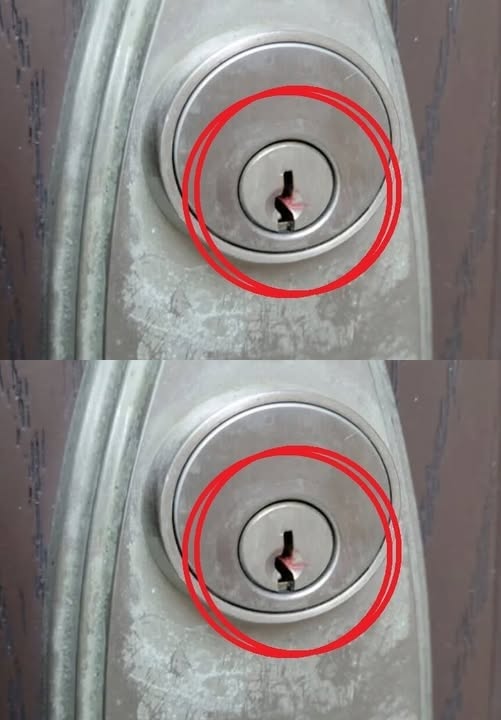
You come home, reach for your key, and notice something unusual on your front-door lock.
A tiny spot of red wax is stuck near the keyhole.
You don’t remember putting it there.
At first, it might seem harmless. Maybe it’s candle wax, a prank, or something that accidentally got onto the door.
But then an unsettling question comes to mind:
Could someone have deliberately marked your home?
Stories online have claimed that burglars sometimes use wax, chalk, tape, or other small markings to communicate information about properties they’ve visited. However, there is no universal system in which red wax has one established meaning, so it shouldn’t automatically be interpreted as a burglary warning.
Why Would Someone Put Wax on a Lock?
The theory is that a small, unusual mark could be used to identify a property that someone has previously inspected.
Some online reports claim such marks may be intended to communicate things such as whether a home appears occupied or whether someone has already examined the property.
But it’s important to distinguish between reports and proven facts.
A colored mark on a door does not, by itself, establish that criminals are targeting a home.
There Could Be a Completely Innocent Explanation
Before assuming the worst, consider the ordinary possibilities.
Red wax could come from:
- A candle or outdoor decoration
- A craft project
- Decorative sealing wax
- A prank
- Wax or residue accidentally transferred from another object
- Someone touching the lock with a wax-covered item
In other words, red wax doesn’t automatically mean danger.
What Makes the Discovery Worth Investigating?
The situation becomes more concerning if the wax appears alongside other unexplained signs.
For example, you might notice:
- Scratches around the lock
- Damage to the door or frame
- An unfamiliar object attached to the property
- Signs that someone has attempted to manipulate the lock
- Repeated markings after you’ve removed the first one
- Unusual activity around your home
One unexplained spot of wax is very different from multiple signs of possible tampering.
Don’t Rely on Internet “Color Codes”
One of the biggest problems with stories about criminal markings is that people often present a particular color as having a universal meaning.
There isn’t a reliable worldwide dictionary saying “red means this,” “blue means that,” or “yellow means something else.”
Even reports that discuss alleged marking systems acknowledge that meanings can vary and that not every unusual marking is connected to criminal activity.
So don’t panic simply because the substance happens to be red.
What Should You Do If You Find It?
You can take a few sensible precautions without assuming you’re being targeted.
1. Take a Photograph
Before cleaning anything, photograph the mark.
This gives you a record of what you found and where it was located.
2. Look Around the Property
Check the other doors, windows, gates, and accessible areas for anything unusual.
You’re looking for evidence of actual tampering, not imaginary patterns.
3. Check Security Cameras
If you have a doorbell camera or other security cameras, review recent footage.
You may discover that the substance was accidentally left by a visitor—or you may notice someone approaching the door.
4. Ask Your Household
Make sure nobody in your home knows where the wax came from.
Sometimes the mystery has a very ordinary explanation.
5. Report Suspicious Activity
If you find evidence of attempted entry or other suspicious activity, contact your local police or appropriate security service and explain exactly what you observed.
You don’t need to claim that the wax is a criminal code.
Simply report the facts.
Should You Remove the Wax?
If you determine that the substance is harmless, you can clean it from the lock.
But if you suspect that someone has tampered with the lock, photograph it first.