
Imagine getting out of bed and suddenly feeling something fall onto your head.
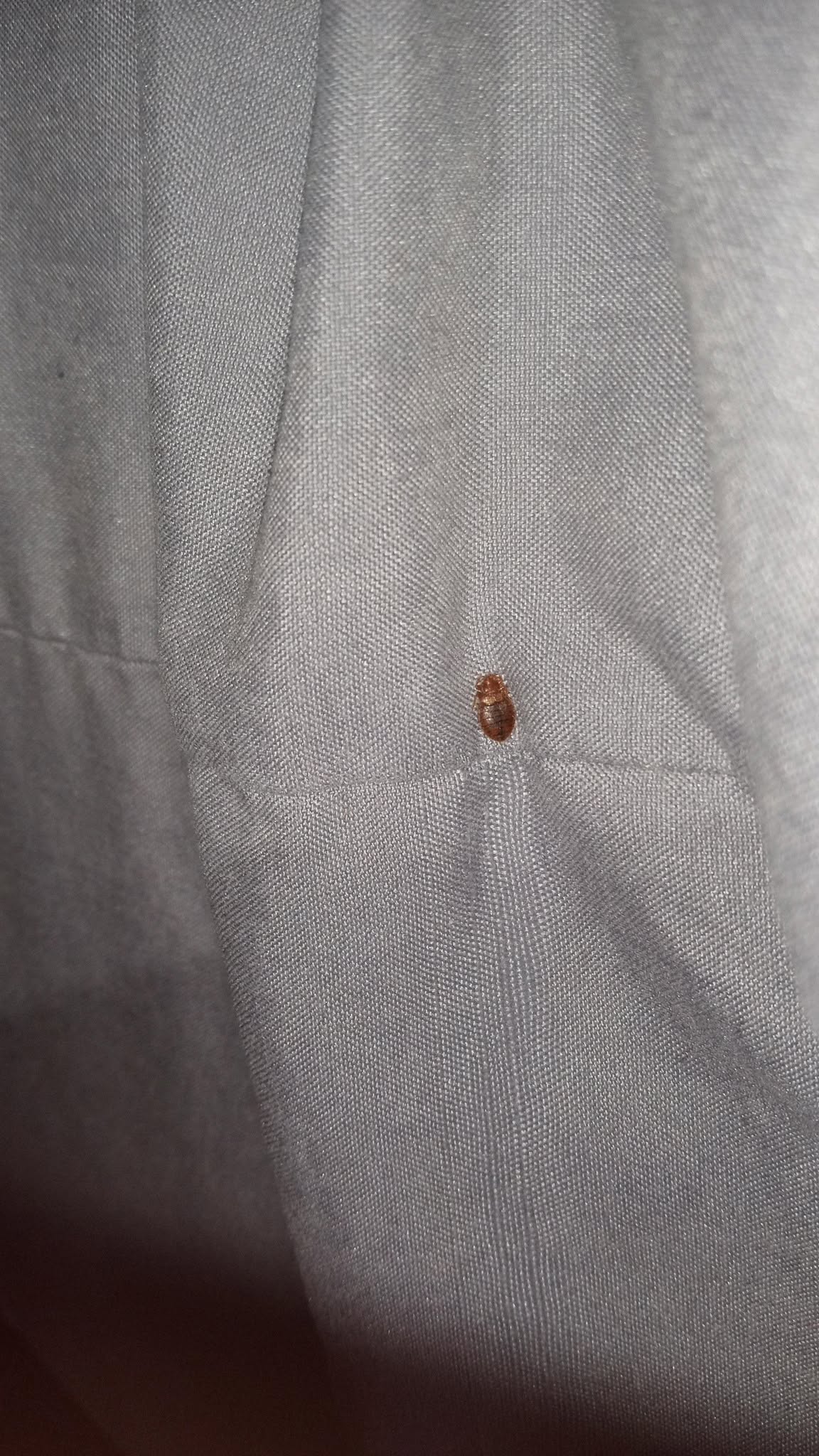
That is exactly what happened to one person’s sister, who lives in a bedroom directly beneath an attic. When they took a closer look at the unexpected visitor, they found a small, reddish-brown bug lying on the fabric.
At first, they suspected it might be a carpet beetle larva.
But the photograph tells a different story.
Is This a Carpet Beetle Larva?
Probably not.
Carpet beetle larvae are usually elongated and covered in noticeable hairs or bristles. They often look fuzzy rather than smooth.
The insect in this photograph appears to have a smooth, oval, flattened body with visible abdominal segments, and it has a reddish-brown coloration.
Those characteristics are much more suggestive of a bed bug than a carpet beetle larva.
However, a photograph alone isn’t enough to make a definitive species identification.
The Shape Is the Biggest Clue
Look closely at the insect.
It appears:
- Small and oval-shaped
- Reddish to reddish-brown
- Relatively flat
- Segmented across the abdomen
- Smooth rather than covered in long hairs
That combination is consistent with the general appearance of a bed bug.
Bed bugs are small parasitic insects that feed on blood and are commonly found around places where people sleep, particularly mattresses, bed frames, box springs, and nearby cracks and crevices.
But How Did It Fall From the Ceiling?
That’s the part that makes this story especially interesting.
If the bedroom is directly underneath an attic, it’s tempting to assume that the insect came from above.
But finding a bug on the floor or on someone’s head doesn’t necessarily tell you where it came from.
It could have been on the ceiling, wall, bedding, clothing, furniture, or another nearby surface before falling.
If this really is a bed bug, the attic itself isn’t necessarily the source.
Bed bugs are much more commonly associated with areas where people sleep and rest.
Don’t Panic After Finding One Bug
Finding a single suspicious insect doesn’t automatically mean the entire bedroom is infested.
But if the insect is confirmed to be a bed bug, it is worth investigating rather than simply throwing it away and forgetting about it.
Look around the sleeping area carefully.
Pay particular attention to:
Mattress Seams
Check the seams, piping, folds, and corners of the mattress.
Box Spring
If there is a box spring, inspect the edges and underside.
Bed Frame
Look inside cracks, joints, screw holes, and other sheltered areas.
Headboard
Bed bugs can hide in tiny gaps around wooden or upholstered headboards.
Nearby Furniture
Nightstands, drawers, and furniture close to the bed can also provide hiding places.
Look for More Than Just Bugs
Sometimes the insects themselves are difficult to spot.
Other clues can include small dark spots, shed skins, eggs, or tiny pale eggshells around hiding places.
Small reddish stains on bedding can also occur if a bed bug is crushed after feeding.
Finding several of these clues together is much more significant than finding one unidentified bug.
What About the Attic?
The attic connection is still worth investigating, particularly if there are other insects appearing in the room.
Attics can harbor many different insects, including beetles, moths, spiders, and other household pests.
But the appearance of this particular insect doesn’t strongly resemble a typical carpet beetle larva.
If multiple bugs are falling from the ceiling, check for gaps around:
- Ceiling fixtures
- Attic access panels
- Cracks around trim
- Vent openings
- Wall and ceiling joints
That can help determine whether something is actually entering the bedroom from above.
Don’t Crush It and Throw It Away
If you find another suspicious insect, try to capture it intact.
Place it in a small sealed container or plastic bag.
A clear photograph from several angles can also help with identification.
Keeping the specimen can be particularly useful if you eventually need a pest-control professional to determine exactly what you’re dealing with.
So, What Is the Bug in the Photo?
Based on its smooth, reddish-brown, oval appearance, this insect looks more consistent with a bed bug than a carpet beetle larva.
But the safest conclusion is:
It looks suspicious for a bed bug, but the photograph alone cannot confirm the identification.
If this was found directly on or near a bed, especially if there are additional bugs, dark spots, shed skins, or unexplained bites, the bedroom deserves a careful inspection.
And if more than one suspicious insect is discovered, getting a professional identification can save a lot of unnecessary guessing.
The biggest clue may not be where the bug came from.
It may be what you find around the bed afterward.
One mysterious bug can be an innocent visitor.
Several matching clues can tell a very different story.