
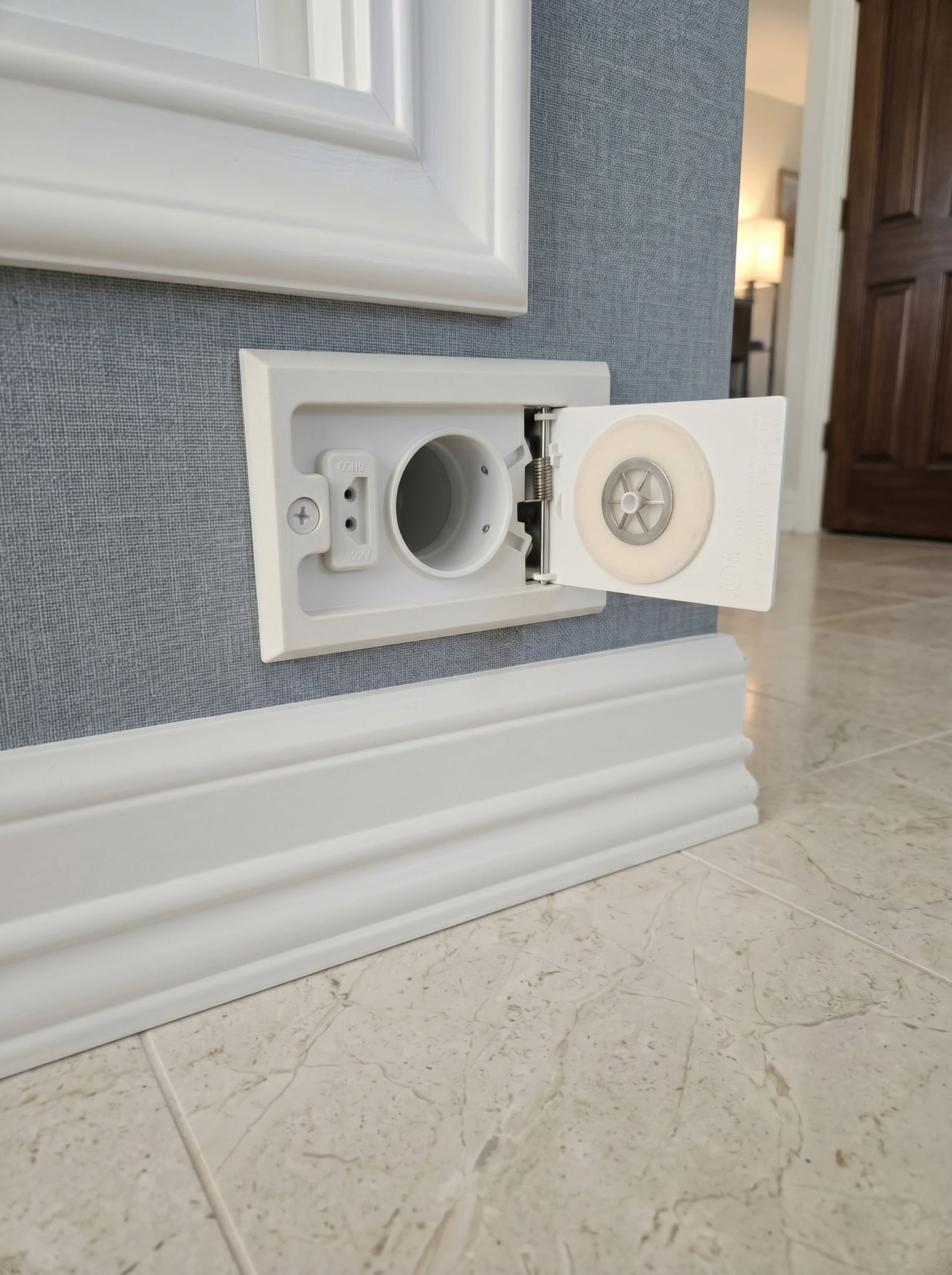
If you just moved into a house and discovered this unusual fixture mounted low on the wall, you’re definitely not alone in wondering what it is.
At first glance, it looks almost like an electrical outlet—but the large round opening and hinged cover make it clear that it’s something quite different.
And the location is an important clue.
This is almost certainly an inlet for a central vacuum system.
It’s a Central Vacuum Inlet
The large circular opening is designed to accept the hose of a central vacuum system.
Instead of carrying a traditional vacuum cleaner from room to room, central-vacuum systems use tubing installed inside the walls of the house. You connect a special vacuum hose to an inlet like the one shown in the photo, and the central power unit provides the suction.
Central vacuum systems commonly use dedicated wall inlets, and manufacturers such as NuTone and BEAM offer replacement inlet valves and related components.
Why Is It Mounted So Low?
That actually makes perfect sense.
The inlet is placed low on the wall so you can easily plug in the long vacuum hose without having to reach up.
Once connected, the hose can be carried around the hallway and into nearby rooms.
Central-vacuum tubing is typically installed inside the walls during construction, which is why these systems can look almost mysterious if you’ve never encountered one before.
What Is the Small Electrical Outlet Next to It?
Look closely at the left side of the fixture.
There’s a small 120-volt receptacle built into the assembly.
That doesn’t necessarily mean the entire thing is a normal electrical outlet.
Some central-vacuum installations include electrical connections associated with powered vacuum equipment or accessories. Central-vacuum systems can be configured with different types of hoses and inlets, including electrically connected systems.
So don’t assume the little socket is simply there for plugging in a phone charger.
How Does the System Work?
The basic idea is surprisingly simple.
You attach the vacuum hose to the wall inlet.
The inlet connects to tubing hidden inside the walls.
That tubing leads back to a central vacuum power unit, usually installed somewhere such as a garage, basement, utility room, or other service area.
When the system is activated, dirt and debris are pulled through the tubing and collected at the central unit.
Some newer homes and specifications specifically include central vacuum systems as part of the house installation.
The Hinged Cover Is Another Big Clue
The little door isn’t decorative.
It protects the opening when the vacuum isn’t being used.
When you need to vacuum, the cover opens and the hose connects to the inlet.
When you’re finished, you remove the hose and close the cover.
That’s why it looks so different from a standard electrical receptacle.
How Can You Tell If Your House Still Has the Vacuum System?
If you want to investigate, look around the house for other identical wall inlets.
Central vacuum systems usually have multiple inlet locations so a long hose can reach different parts of the home.
You can also check the garage, basement, utility room, or another mechanical area for a large vacuum power unit.
It may look somewhat like a large canister mounted to the wall.
What If You Don’t Have the Vacuum Equipment?
That’s possible too.
The previous owner may have removed the central vacuum power unit while leaving the original wall inlets behind.
If the house was built with the tubing already installed, the system may potentially be restored with the appropriate equipment and hose.
Before buying anything, however, it’s worth identifying the exact inlet type and determining whether the hidden tubing and wiring are still intact.
So What Is It?
The mysterious fixture in the photo isn’t a forgotten electrical outlet or some strange 2005-era gadget.
It’s most likely a central vacuum hose inlet.
And once you know what you’re looking at, the large round opening, hinged cover, low mounting position, and nearby electrical connection all start to make sense.