
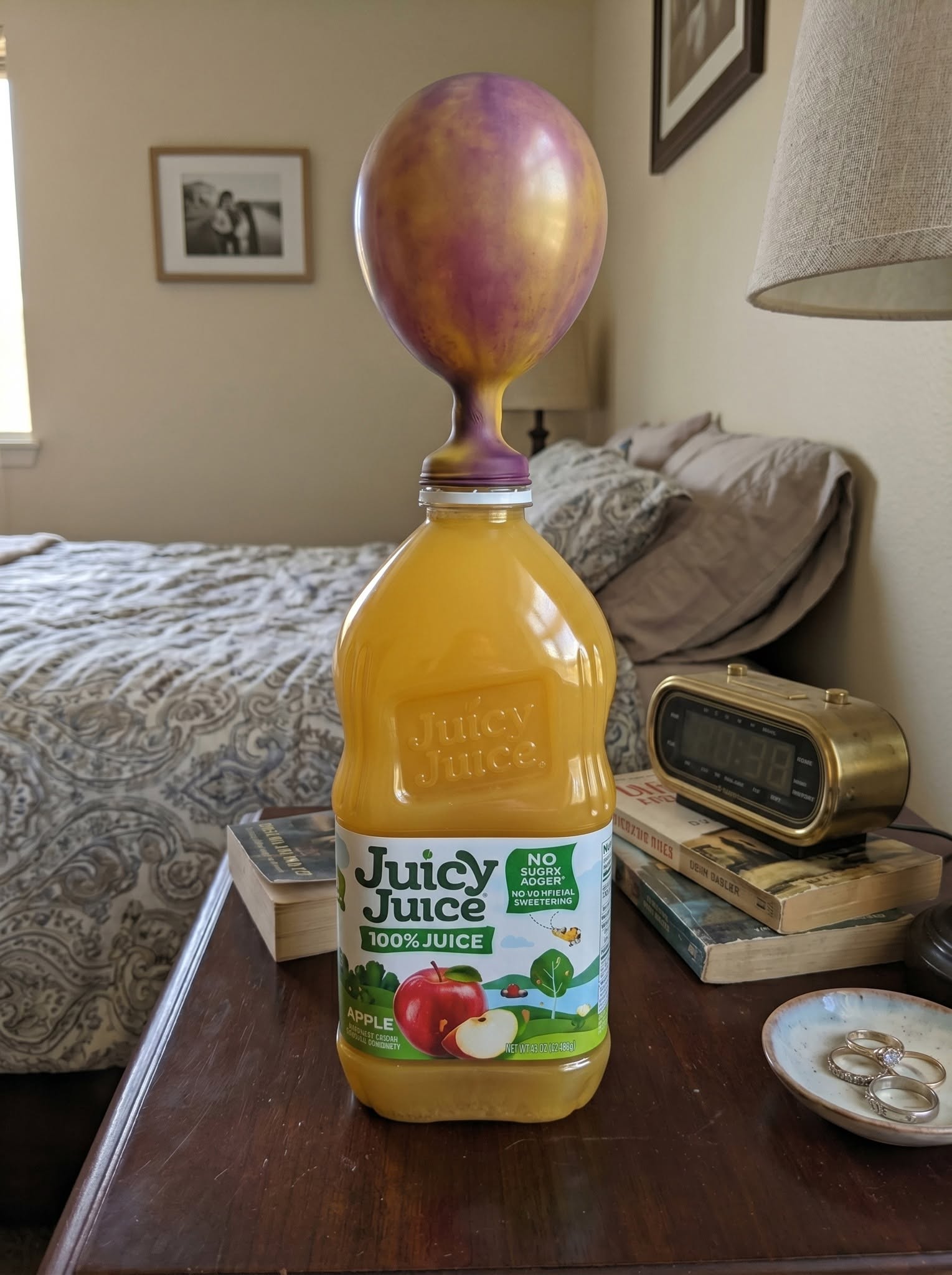
If you found this in your teenage niece’s closet, it’s understandable that you stopped and wondered what on earth you were looking at.
At first, it looks almost like someone turned a bottle of apple juice into a bizarre science experiment.
And honestly, that’s not far from the truth.
The setup in the photo—a bottle of juice with a balloon fitted tightly over the opening—is commonly associated with fermentation.
So What Is the Balloon Doing There?
During fermentation, microorganisms such as yeast can consume sugars and produce carbon dioxide gas.
That gas needs somewhere to go.
A balloon fitted over the bottle can expand as gas is produced, making it a very simple visual indicator that gas is being generated. Similar balloon setups are commonly used to demonstrate fermentation and gas production.
The balloon can also act as a basic barrier, helping prevent outside air and contaminants from freely entering the container while gas escapes.
Why Apple Juice?
Apple juice contains naturally occurring sugars, which makes it a common starting material for fermentation experiments.
That’s why a setup involving sweet juice + a balloon over the bottle immediately raises the possibility that someone is experimenting with fermentation.
However, the photo alone cannot tell us exactly what was inside the bottle or what your niece intended to do with it.
It could potentially be a science experiment, a fermentation project, or simply an unusual homemade setup.
The Balloon Is the Biggest Clue
The balloon isn’t normally part of an ordinary juice container.
Its presence suggests that whoever assembled this wanted to observe or manage gas production.
In educational demonstrations, balloons are used to show how fermentation produces carbon dioxide. As gas accumulates, the balloon expands, providing an easy visual indication that a reaction is taking place.
Could It Be Making Alcohol?
Possibly—but you can’t determine that from the photograph alone.
If yeast ferments the sugars in fruit juice, alcohol can be produced as a byproduct along with carbon dioxide. That’s why similar balloon-on-bottle arrangements are sometimes used in homemade alcoholic fermentation.
But the presence of a balloon doesn’t prove that alcohol is being made.
A very similar setup can be used simply to demonstrate fermentation and gas production.
One Important Thing: Don’t Taste It
If you don’t know what was added to the bottle, don’t drink it or taste it to figure out what it is.
The safest approach is to ask your niece what the experiment is and what ingredients she used.
If it is an active fermentation, the container can also produce gas and pressure, so it shouldn’t be tightly sealed without an appropriate way for gas to escape.
What About the Giant Balloon?
That’s actually consistent with the basic idea.
As carbon dioxide accumulates, the balloon can inflate. Educational demonstrations use this exact principle to make otherwise invisible gas production visible.
So the strange-looking setup isn’t necessarily anything mysterious.
The simplest explanation:
The balloon is probably there to capture or indicate gas produced inside the bottle—most likely as part of a fermentation experiment.
Whether it’s a harmless science project or something intended to produce an alcoholic beverage, however, the photo alone can’t establish that.
If I found this in a teenager’s closet, I’d be less concerned about the balloon itself and more interested in simply asking: