
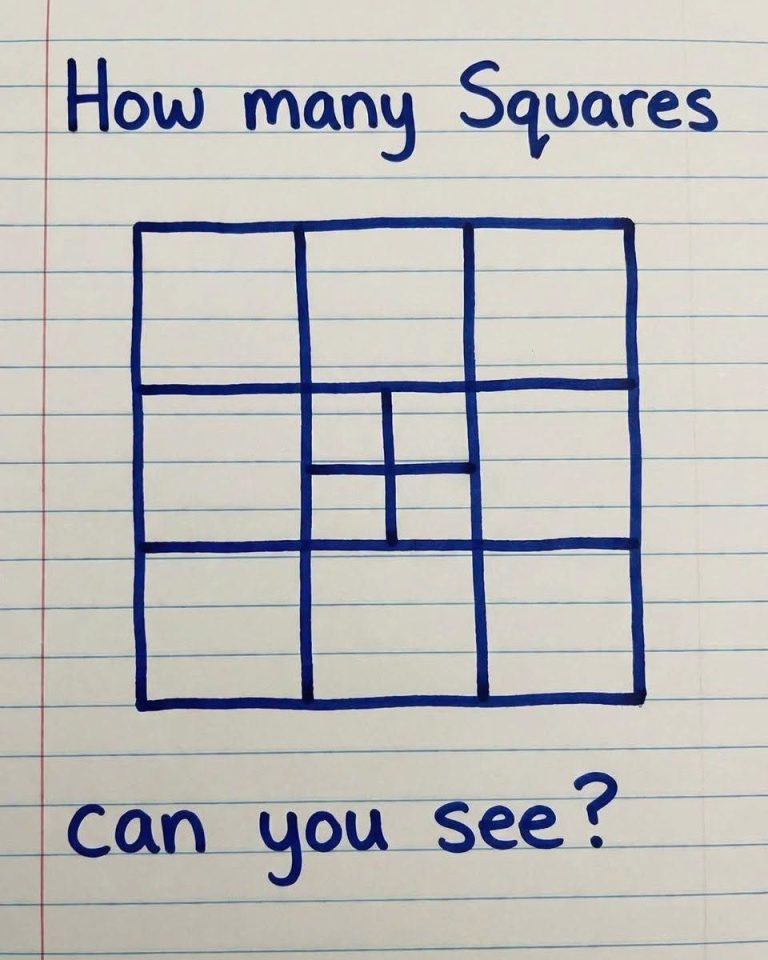
You counted, got a number, and now you’re second-guessing it — which is exactly what this puzzle is designed to do. Because the answer depends entirely on the grid in your image, this page won’t hand you a single number. Instead it gives you a foolproof counting method so you can be sure yours is right, and understand why almost everyone’s first guess comes in too low.
Look closely at the image. How many squares can you see? (Hint: don’t forget the big ones made of smaller ones.)
How to solve it: count squares by size, not all at once. Add up the 1×1 squares, then the 2×2, then the 3×3, and so on up to the whole grid. The overlapping bigger squares are what people miss.
Why your first count is almost always too low
When you glance at a grid, your eye locks onto the smallest cells and stops there. A 4×4 grid “looks like” 16 squares and you move on. But a square doesn’t have to be a single cell — any block of cells that forms a square counts too. Those larger squares overlap and share edges, so they hide in plain sight. The riddle’s own hint is the giveaway: don’t forget the big ones made of smaller ones.
The method that never misses
Work through the grid one square-size at a time so nothing slips past you:
- Count the 1×1 squares. These are the individual cells — the obvious ones.
- Count the 2×2 squares. Slide an imaginary 2×2 window across the grid: left to right, then down a row, and repeat. Count every position it fits.
- Count the 3×3 squares, then 4×4, and keep going until the biggest square you can fit is the whole grid itself.
- Add all the totals together. That sum is your answer.
The shortcut for a perfect square grid
continue to the next page ………
If your image is a clean, complete grid with no lines cut off — say an n × n grid — there’s a formula that gives the exact total: add up the squares of each number from 1 to n.
- A 2×2 grid: 4 + 1 = 5 squares.
- A 3×3 grid: 9 + 4 + 1 = 14 squares.
- A 4×4 grid: 16 + 9 + 4 + 1 = 30 squares.
- A 5×5 grid: 25 + 16 + 9 + 4 + 1 = 55 squares.
So if you can see the grid is a simple 4×4, the answer is 30, not 16. Count the rows and columns in your image, then match it to the list above.
Why these puzzles get “debated” in the comments
Two things make people argue. First, many of these Facebook images aren’t clean grids — they add an extra line, a rectangle inside a cell, or a stray shape, which creates a few bonus squares the tidy formula won’t catch. Second, some people count rectangles too, or miscount the grid size. That’s why the same picture can honestly produce several different totals. If your grid has any lines that don’t run the full width or height, count those extra small squares by hand and add them on top of the formula.
Your move
Try it now: name your grid size, run the size-by-size count, and see if it matches the formula. If your picture has an odd extra line, tell me what you see and drop your number in the comments — half the fun of these is comparing counts and spotting the square everyone else walked past. Then pass it to a friend who’ll confidently say “sixteen” and stop there.